Mock’s Hold — candidate review
Music and sound — first listening candidates
Three original arrangements share a short theme. Listen against identical 30-second Godot staging, then compare the isolated loops. B — Chamber / On the Battlement is your chosen direction. All recordings and sound effects remain drafts. These are instrumental sketches rendered with FluidR3 GM, rather than a finished orchestral recording.
B · Restrained chamber
Same movement, ambience and effects in every film. Switching candidates retains the scene position. This is a condensed staging study with no added dialogue; it is separate from the full book timeline. Films include sound. Direction and reproduction notes.
A - Smoke over Malaz
Melodic JRPG: flute theme, harp movement, warm strings and cello.
26.7s loop · 72 BPM · Editable MIDI · Note arrangement
B - On the Battlement
Restrained chamber: English horn, viola, cello and sparse harp.
30.0s loop · 64 BPM · Editable MIDI · Note arrangement
C - An Uneasy Empire
Dark ambient: low strings, contrabass, isolated vibraphone and fragments of the theme.
30.0s loop · 64 BPM · Editable MIDI · Note arrangement
Battlement ambience
30-second wind loop, filtered from Luke.RUSTLTD’s CC0 PureData wind. This is synthesized wind, not a field recording. The vane squeal is triggered separately at relevant book paragraphs. No nearby battle or fire sounds are added.
Individual effect candidates
Stone footstep candidateFootstep with light equipmentCloth movementSmall metal movementRusty vane: synthesized friction studyDialogue advanceOptional dialogue tick
In Godot, F3 opens the audio panel: choose A/B/C or music off, adjust master/music/ambience/effects/dialogue volumes, and optionally enable quiet text ticks. U mutes everything. The scene pauses while the panel is open; music and wind continue for listening. Footsteps follow animation contact frames, including the faster running cycle.
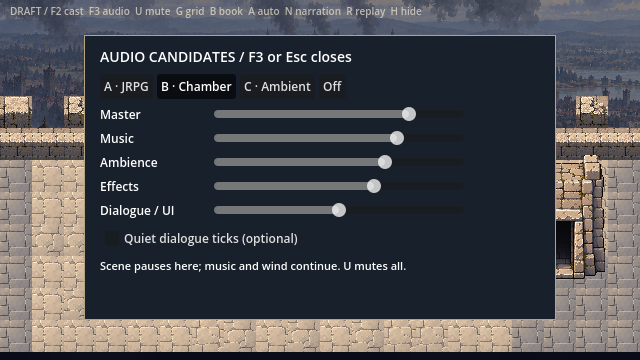 Godot audio panel; settings persist locally
Foley: Kenney’s CC0 RPG sound pack. Wind: Luke.RUSTLTD, CC0. Instrument samples: FluidR3 GM, MIT. MIDI arrangements and the synthesized UI/vane effects were authored for this project. Credits · Audio manifest.
Current prologue — dialogue and staging
Dialogue only: no narrator or internal-thought boxes. All 48 speaking paragraphs remain in order, with punctuation corrected where prose dialogue tags were removed. The tower is attached to the wall; the extra stair fragment is gone. Commander and Fiddler watch upright, avoiding the lean-height jump. Ganoes keeps his approved tiptoe geometry.
Current 1080p/60fps capture with Chamber B, facial-mask expression blends, blacker Ganoes hair and 70-character/second typewriter reveal. Manual advance remains available in Godot. Walking defects listed below are still being refined; this film does not imply every animation is approved.
Punctuation audit · Body and animation contract
Exit timing close-up
Surly leads. Arrival times at the door are staggered by 0.65s; each character disappears independently at the threshold.
Run ./run.sh, or press F5 in Godot. F2 opens the cast gallery; A switches autoplay.
Current motion repairs and proportion pilot
Current Surly support correction, an unselected smaller-head Surly pilot, and Fiddler previous/revised run and walk. The pilot is deliberately separate: its head is smaller than our chosen chapter-one body reference, so a full cast migration is not yet selected.
What changed and what remains · Proportion and animation rules
Earlier study: Fiddler anatomy
The revised walk and idle preserve a complete head, neck and torso from the newer drawing. The previous export pasted an older head/back rectangle over the moving body to stabilise the fiddle. That patch is removed. The eight timed weight phases remain; running and leaning already preserve their complete anatomy and are shown unchanged for comparison.
Previous above, revised below; south, west, east and north. Historical v7 comparison; the current build uses the additional contact and side-walk revisions shown above. The fiddle is still painted into this candidate. Future removable equipment will use an intact base body plus an accessory layer, with the same body proportions and root. Revision notes.
Earlier study: walking weight
The previous walk appears above and the revised version below, at matched cycle times and travel speed. Head, shoulders, body and equipment move together by a small integer-pixel offset. Ganoes and Fiddler have a 2-pixel low-to-high range; the commander and Surly use a restrained 1-pixel dip. Each key drawing’s planted sole keeps its position through a tiny boot-edge adjustment.
Eight timed weight phases reuse the existing four limb drawings; these are not eight newly drawn leg poses. The 11-second Godot clip shows south/west/east/north and scripted travel. This clip predates Fiddler’s v7 anatomy correction shown above; the current game and gallery use the later contact and side-walk revisions. Frame timing follows actual travel speed. Study notes and reproduction.
References: schwarnhild’s free four-direction NPC, SLYNYRD’s walk-cycle breakdown, SLYNYRD’s top-down animation study.
Smooth expression changes
Selected expressions now preserve every pixel outside explicit facial masks. Hair, clothes and alpha silhouette are identical to neutral. Expressions blend in place over 0.20 seconds. The same feature is used by dialogue and the cast gallery. Each speaker remembers their last expression; character changes switch cleanly. Portraits keep their alignment and pixel sampling, and dialogue continues during the blend.
11-second Godot preview: all four cast members, followed by the actual dialogue component with expression-preview captions. Try F2, choose a character with 1–4, and press Tab to cycle emotions. Quickly cycling expressions keeps the latest choice queued until the current short blend finishes.
Cast at actual game scale
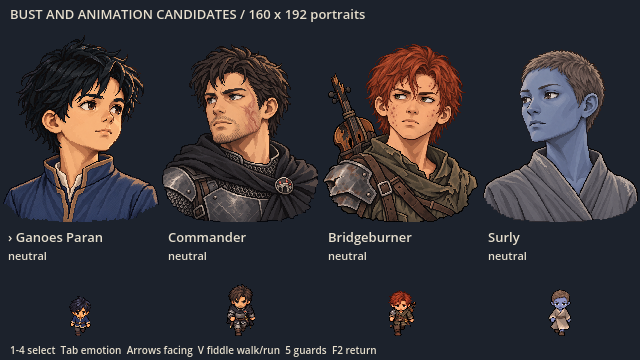 Actual Godot render: 160×192 portraits and 48×64 sprite cells
All five sprite models share the same frame contract. The twelve-year-old, adolescent and adults have different body heights inside those cells. Generated poses are sliced and aligned around the head. Earlier walk exports use fixed face/core patches; Fiddler’s current walk/idle preserve their complete source anatomy; running preserves complete anatomy; the commander and Fiddler now watch the wall upright. Four speakers now use eight timed phases in 384×256 walk sheets, based on four key drawings; the acolyte retains its earlier three-column sheet. These remain art candidates.
Fiddle-carrying Bridgeburner, adolescent
Young, pockmarked, red-haired, mismatched worn armour, fiddle and scabbard. Revised face removes the first draft’s invented linear scars. Instrument damage needs clearer pixel work.
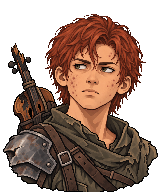 neutral
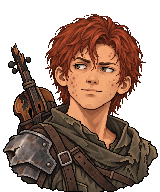 wry
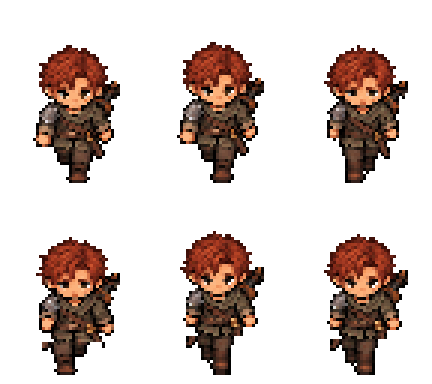 South walk, enlarged 3×
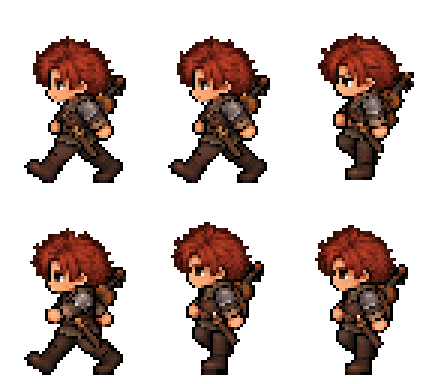 West walk, enlarged 3×
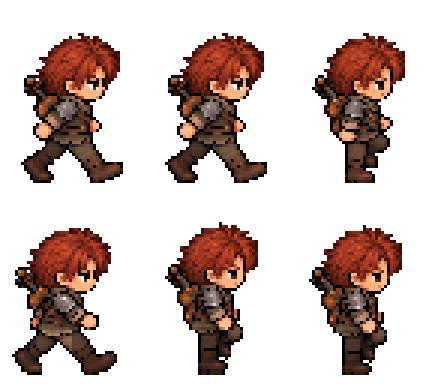 East walk, enlarged 3×
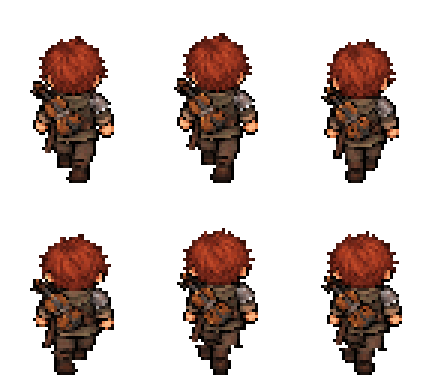 North walk, enlarged 3×
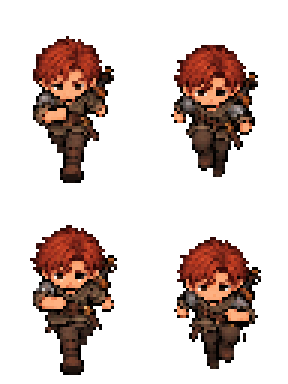 South running, enlarged 3×
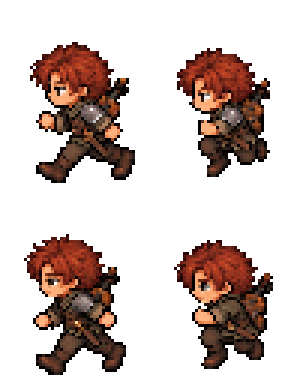 West running, enlarged 3×
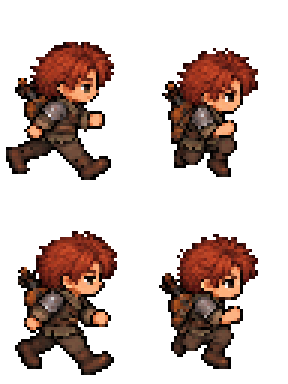 East running, enlarged 3×
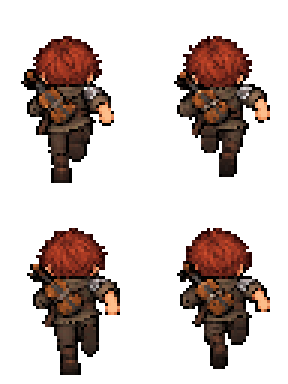 North running, enlarged 3×
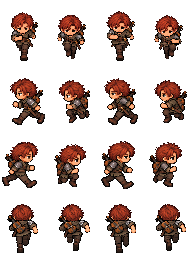 Four-direction run sheet
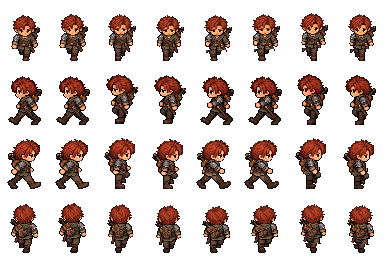 All four direction rows: south / west / east / north
Claw acolytes
One reusable faceless black-robed model plays both guards. No large portrait, visible eyes or invented insignia.
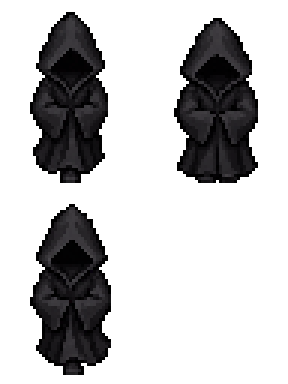 South walk, enlarged 3×
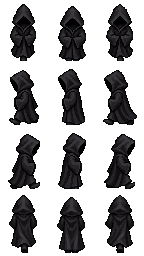 All four direction rows: south / west / east / north
Book fidelity and remaining problems
The book takes priority. Later chapters may guide appearance continuity; the prologue determines age, clothing, equipment and action for this scene.
- The first backgrounds’ flags and invented heraldry are absent. Mock’s Vane is a rusty winged demon on an old pike, not a banner.
- The revised panorama concentrates smoke at the distant inland edge, leaving intervening city mostly intact. Exact buildings, city scale and bridges are visual interpretations.
- All 58 quoted speech fragments from the supplied prologue are preserved, in order, across 48 speaking paragraphs. Attributions remain in the original-paragraph reference view (B); the game displays only spoken dialogue. Eleven tag-ending commas become full stops and one tag comma is removed from an interrupted sentence; original fragments remain unchanged in source metadata.
- The commander and fiddle soldier use the prologue’s unnamed speaker labels. Surly’s label changes to Laseen after her correction.
- Current motion pass: darker north heels, alternating Surly support, revised Fiddler side-walk contacts/passing poses and stronger north/south running. These remain review candidates. The broad six-column replacement trials were rejected; the more natural Surly pilot is shown separately and is not mixed into the cast.
- The raised tower is now selected and routes use its doorway. Dedicated tower edge tiles could refine the joins further.
- Stone texture remains busier than the portraits. There is a shared-palette experiment, but palette cleanup has not been silently applied to the current cast.
- Dialogue uses a plain readable system font. Decorative pixel typography and final cinematic timing remain future work. First music and sound candidates are available in the audio section and current game.
First review decisions: cast identities and ages, small-sprite proportions/motion, large versus compact bust layout, and the battlement composition. You can refer to a character, expression, animation frame or map coordinate.
Interactive controls
Space / Enter / click reveal or advance · A autoplay · B source paragraph · F2 gallery · G grid · L bust size · M floor · H hide review bar · F11 fullscreen · R restart.
Gallery: 1–4 choose a speaker, Tab cycle expression, arrow keys change facing, V toggles the fiddle soldier’s walk/run, 5 guards. Gallery and book views pause the cutscene. There are no player movement controls.
Selected game files and generation prompts
Selection means “used in this review build”; no candidate is approved. Earlier sources and rejected outputs are retained for history. Full manifest with source hashes.